
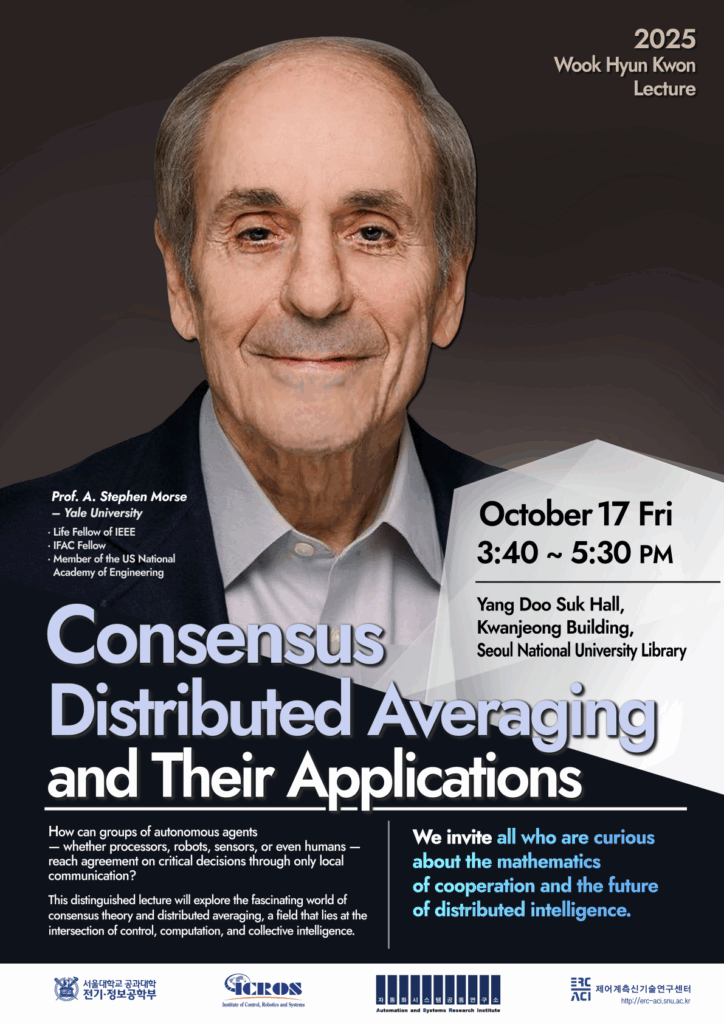
Lecture: “Consensus, Distributed Averaging and Their Applications”
Date & Time: October 17 (Friday), 2025, 3:40 ~ 5:30 PM
Place: Yang Doo Suk Hall, Kwanjeong Building, Seoul National University Library
For a long time now there has been ongoing interest in distributed decision making problems of many types. Perhaps the most fundamental of these is the “consensus problem” which roughly speaking is the problem of devising local protocols for the members of a group of autonomous agents (e.g., processors, robots, birds, humans, etc.) which can enable the agents to agree on the value of some entity using data iteratively obtained from neighboring agents over a communication network. The problem has been widely studied in many fields including economics, finance, computer science, control, signal processing, and robotics. Many questions arise: What are some provably correct protocols for achieving consensus and at what rates do such protocols accomplish this? What are some of the tools used to quantify convergence rates? What happens if agents do not share a common clock and decision making is consequently asynchronous? What happens if there are communication delays over the network? What happens if the communication between agents is in some sense limited? How might consensus be used to help perform a distributed computation such as finding a solution to a system of linear equations, or finding a common fixed point of a family of nonlinear maps? What are the answers to these questions when the consensus problem is particularized to the “distributed averaging problem” which is special case where the objective is to compute in a distributed way, the average of a set of real, scalar variables (e.g., temperature) spread out across a network. How do algorithms such as linear iterations, double linear iterations, and gossiping policies address this problem? These are some of the issues to be discussed in this lecture.
Tutorial Lecture: Finding a Common Fixed Point of a Family of Paracontractions
Date & Time: October 18 (Saturday), 2025, 9:30 AM ~ 12:30 PM
Place: Room B101, Building 43-2 dong, Seoul National University
“Paracontractions” are nonlinear maps which arise in certain optimization and estimation problems and in various types of numerical calculations. In this talk a distributed algorithm is described for finding a common fixed point of a family of m>1 paracontractions M_i: R^n -> R^n assuming that such a common fixed point exists. The common fixed point is simultaneously computed by m agents assuming each agent i knows only M_i, the current estimates of the fixed point generated by its neighbors, and nothing more. Each agent recursively updates its estimate of the fixed point by utilizing the current estimates generated by each of its neighbors. Neighbor relations are characterized by a time-dependent directed graph N(t) whose vertices correspond to agents and whose arcs depict neighbor relations. For any family of paracontractions M_i, for i in {1, 2, …, m}, whose members have at least one common fixed point, and any sequence of strongly connected neighbor graphs N(t), t = 1, 2, 3, …, the algorithm causes all agent estimates to converge to a common fixed point. Generalizations of this result are also discussed. Finally, as an application of these results, a provably correct and resilient distributed algorithm is described for estimating the state of an m-channel linear system of the form dot x = A x and y_i = C_i x for i in {1, 2, …, m}.
Handouts will be provided, containing copies of the slides shown.
2025 Lecturer: A. Stephen Morse
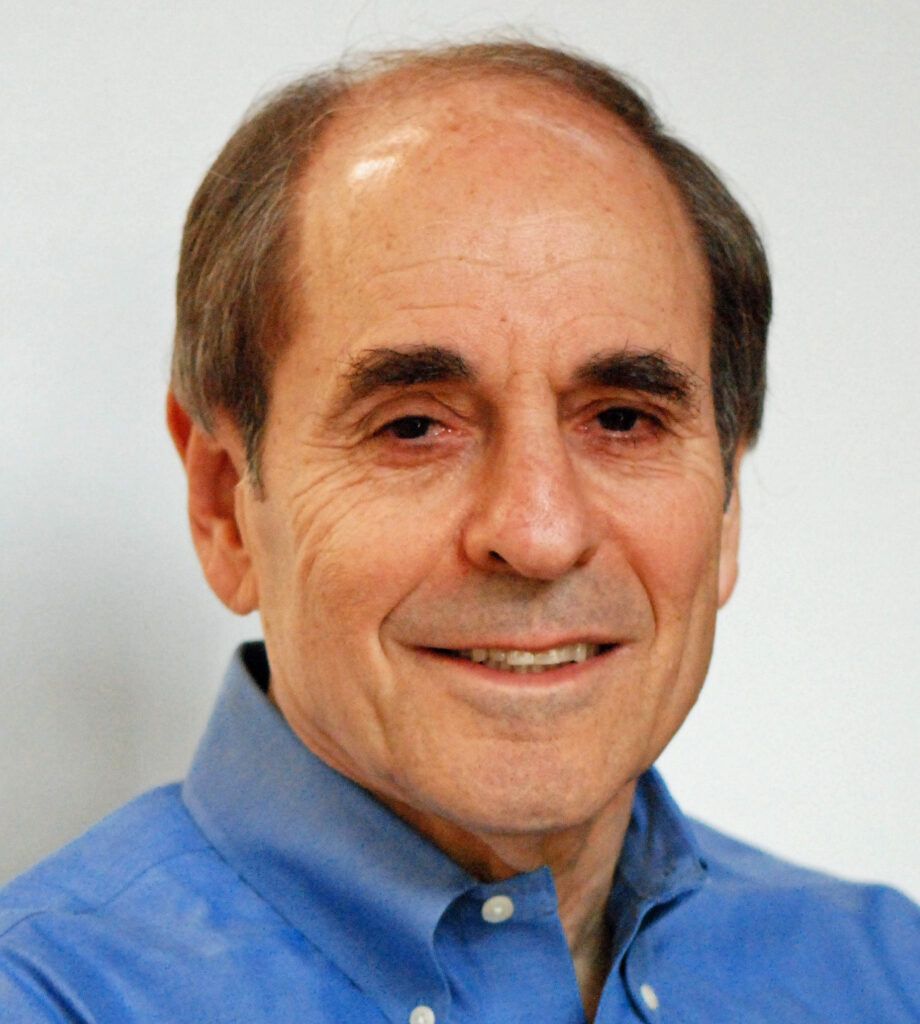
A. Stephen Morse received his Ph.D. degree from Purdue University in Electrical Engineering. He spent the next three years with the Office of Control Theory and Application {OCTA} at the NASA Electronics Research Center in Cambridge, Massachusetts. Since 1970 he has been with Yale University where he is currently the Dudley Professor of Engineering. His main interest is in system theory and he has done research in network synthesis, optimal control, multivariable control, adaptive control, urban transportation, vision-based control, hybrid and nonlinear systems, sensor networks, and coordination and control of large groupings of mobile autonomous agents. He is a Life Fellow of the IEEE, an IFAC Fellow, a past Distinguished Lecturer of the IEEE Control System Society, and a co-recipient of the Society’s 1993 and 2005 George S. Axelby Outstanding Paper Awards. He has twice received the American Automatic Control Council’s Best Paper Award and is a co-recipient of the Automatica Theory/Methodology Prize. He is the recipient of the 1999 IEEE Technical Field Award for Control Systems, the American Automatic Control Council’s 2013 Richard E. Bellman Control Heritage Award, and the International Federation of Automatic Control’s 2023 Giorgio Quazza Medal. He is a member of the US National Academy of Engineering and the Connecticut Academy of Science and Engineering.
Event Photos: https://1drv.ms/a/c/2498b37059dfe4fd/Ev7aI-wdyRlAri3ZYmlY6eUBfj_zUzwFb7OcDiEnGBPoow?e=0wHYsP